Tuesday, 18 October 2011

The vice man cometh


Here's my latest piece for the South China Morning Post's Postmagazine. Say what you will about Chuwit ... he gives good quote. Pix by the talented Mr Cedric Arnold.


Super Pimp casts a long shadow over Bangkok. Wherever you turn, there he is, on televisions, newspapers, laptops, billboards, beetroot face contorted into its trademark twisted rictus, moustache aquiver with indignation and finger jabbing at some imagined outrage, ready to launch his next blow against corruption and injustice. One can almost imagine him swooping down from out of the sun, pimp cape flapping, patrolling the phalanx of fleshpots he built then disowned, eyes peeled for fresh perps.
    Every metropolis gets the superhero it deserves. For the City of Angels, a town built on graft and grease and dirt and deals, on tortuous alliances and labyrinthine loyalties, internecine squabbles, snout-in-trough sweeteners and baht pro quo backscratching, who could be more suitable to step forward and save the day than the flawed, fabulously entertaining and batshit crazy crusader that is Chuwit Kamolvisit?
    Thailand’s former massage parlour king and self-professed pimp turned Member of Parliament is reveling in his role as thorn in the government’s side, whistleblower and stirrer in chief, elephant in the room and motor-mouth maverick. After winning four seats in the recent election - a result that shocked many but revealed a deep-seated disgust amongst Bangkok’s middle class with the two big parties, the defeated Democrats, still headed up by faded poster boy Abhisit Vejajiva, and the governing Pheu Thai party, led by Yingluck Shinawatra, Thaksin’s sister, savior and stooge – Chuwit is still riding high in popularity polls. And with a deep-seated fear abroad that the blood-soaked belligerence of the red-shirts and yellow-shirts may not yet be consigned to history’s dustbin, locals are lapping up the comparatively light relief of the Chuwit sideshow while it lasts.
     The pimp tag is not something that bothers him; rather, he has embraced it. “It’s OK. I was a pimp,’’ he says. “I did what I did in the past, I owned a lot of massage parlours. Of course I sold them all, but I can’t complain if people still want to call me pimp.
    “Anyway, a politician is worse than a pimp, worse than a whore. I adore the whore. The whore trades something that she owns, her body, while the politician trades the country and what belongs to the people. So I say, go head, call me a pimp. I am Chuwit, Superpimp. Just don’t call me a politician."
      It’s tempting to suggest he invest in a superfly mink-lined cape, perhaps a natty purple fedora and diamond-studded cane. As it is, his one concession to ghetto fabulous is his bull terrier, Motomoto, who was a prominent part of Chuwit’s election efforts and featured on the most entertaining of his talk-of-the-town campaign posters.  “I used my dog as a symbol of honesty, loyalty, everything you can’t get from the politician,’’ he says.
      His Lazarus-like return to politics surprised some, who had written him off after his last run at Bangkok governor ended in ignominy and bruised knuckles. Chuwit lost his temper on live television and punched and kicked a popular television anchor who had questioned his manliness.
    His continued existence amazes many, who believe it’s a miracle that he hasn’t already been helped on to his next life by a hitman, given the fuming coterie of top cops, army generals and political powerbrokers he has embarrassed and cost large amounts of money. Now, his latest mission to expose Bangkok’s thriving illegal casinos – including threats this week to reveal a massive new establishment with an alleged key Hong Kong backer – has the entire city transfixed.
    Chuwit, leader of the Rak Thailand Party, a month ago upstaged PM Yingluck’s maiden policy speech with his video-backed bombshell about a huge and professionally run casino in Bankgok’s Suttisan district operating a stone’s throw from a major police station. The fallout was extensive, provoking a frenzy of buck-passing and butt-covering, and eventually costing the police commissioner his job.
      Now he’s at it again. This week, Chuwit said he would divulge details of a new mega-casino in Huay Kwang’s Mengjai district, which he claims is a joint venture between a former cabinet minister and a wealthy Hong Kong investor.
    The key Hong Kong connection was a shadowy casino specialist he would only name as "Mr Tee" who had extensive experience in Macau and also at the casinos in the Cambodian border town of Poipet. The main local partner was reportedly a former cabinet minister, Chuwit said.
     His latest claims are backed by the deputy prime minister and new Thai government vice tsar, Chalerm Yoobamrung, who said the government was keeping a close eye on illegal casinos under construction. He said the government was aware of a "significant" Hong Kong investment in Thailand's illegal gambling underworld.
   "It's like a joint venture," Chuwit explains. "This guy Mr Tee, he has the international casino connections and the expertise. The local partner secures the premises and deals with the police and other officials. Mr Tee makes sure the security system, the computer and gaming technology, the lighting, the equipment and most importantly the croupiers, dealers, counters, cashiers and other key staff are all experienced casino employees. Because they know very well, if you have staff you can't trust they will rob you blind."
    "To fit out one of these casinos takes up to two months and costs around 100 million baht [HK$25 million]," Chuwit said. "But ... they make a nightly profit of around 10 million baht. Police are getting fat off them and it looks like I'm the only one with enough guts to tell it like it is," he said. "You've got high rollers, roulette, baccarat, blackjack, bok dang, croupiers in uniforms, computerised equipment, money counters ... but to police it's obviously all invisible."
     The new casino was located about 500 metres from the Meng Jai intersection in Huay Kwang district - ironically the same district where many of Chuwit's former massage parlours were located. He said the casino was ready to start operating. It was one of at least four being developed with Hong Kong backing.
     When Chuwit told Parliament last month about a big illegal casino in Suttisan Road, Bang Sue district the disclosure led to the transfer of three senior police officers to inactive posts, a city-wide crackdown and a political firestorm, which claimed the scalp of National police chief Wichean Potephosree.
     This week, acting national police chief Priewpan Damapong said police had searched the area and could find no gambling facility or evidence of one under construction. When apprised of this, Chuwit goes into paroxysms of laughter over the telephone. “Of course they are going to say that. These are the same cops who couldn’t see the Suttisan casino that was operating a couple of doors down from a major police station.’’
    In what may be a warning shot over Chuwit’s bows, however, the Supreme Court this week ruled to seize Bt3.4 million from the MP in connection to his suspected involvement in a prostitution ring. A lower court and subsequent appellate review had previously ruled in Chuwit’s favour, but the high court took the view that he had failed to verify how the assets in question were acquired.
     While Chuwit’s defence team argued that massage parlours were a legitimate business, the high court ruled there was enough evidence to support the parlours being used as a front for the sex trade, as evidenced by company records showing Bt 112,559 spent on condoms alone in 2002.


When I meet Chuwit on a drizzling Bangkok afternoon in the park that bears his name in Sukhumvit Soi 10, he is riding high on his first salvo about the illegal casinos but yet to launch his second strike. He has a gruff and affable charm but you sense a mercurial temper is simmering somewhere close to the surface.
    It’s clear he gets a kick out of owning such a valuable piece of real estate and using it mainly as a private playground for his dog. “Yes, it’s true. You could say Motomoto is the owner here. One day I might do something here, but this is the last real prime undeveloped Sukhumvit Rd site. So I am happy to sit on it for a while.’’
     Chuwit says he was surprised to win as many as four seats in the election, but not surprised that he himself was comfortably elected. “In my campaign, I presented myself as boring. Thai politicians play politics too much. They talk, talk, talk, but never do anything.’’
     Fighting corruption was Chuwit’s main campaign promise. “Corruption in Thailand is supported by the officials, the politicians, the police, the system. Nobody wants to talk. It’s a big issue in this country.’’ Which might seem a bit rich coming from a man who gleefully detailed the staggering amount of bribes in cash and other largesse he paid to all manner of Thai officials to facilitate his business in its heyday.

     Chuwit strokes his moustache and looks to the heavens. “Look, have you seen the movie ‘Catch Me If You Can? You’re not going to catch a crook by using a good guy. I am the one who knows the (corruption) process better than anyone. So I can make myself useful now to expose corruption. ‘’ It takes a thief to catch a thief? “Exactly!’’
      Can one man really accomplish anything? “Corruption is so strong in Thailand I don’t think it will ever change. I’m not saying I can do anything. But I have vowed to try.’’
    The last time Chuwit was making these kind of waves was in 2004, where he kept Bangkok on the edge of its seats with lurid revelations of police corruption relating to his massage parlour business. The sensationally sordid saga of sex, bribes and videotape hit the front pages when Chuwit revealed that he was paying senior police from four of Bangkok’s biggest police districts over 12 million baht in bribes per month (not a bad sweetener when you consider the average constable’s salary barely breaks four figures). Chuwit also spoke of how he showered the officers with trays of Rolex watches shipped in from Hong Kong and crates of the finest French vintages.
      He didn’t name names, but said he had a list prepared to do just that in the event of his untimely demise, not to mention lurid details of the peculiar sexual proclivities of some of the city’s top cops, some reportedly captured on camera. His tirade was prompted by what he deemed a betrayal by men he had made extremely wealthy and who he paid to protect him. This followed the infamous January 2004 midnight raid in which armed thugs reduced to rubble a motley collection of beer bars and small businesses in what used to be known as Sukhumvit Square. The raid shocked Bangkok, embarrassed the police and angered the government. Chuwit had recently bought the land in question, although he denied authorising the raid and claimed it was orchestrated by a man he had agreed to lease the land to. (Later, in the face of a mounting furore, he magnanimously decided not to develop the land but to turn it into a public park).
    A warrant was issued for Chuwit’s arrest, and he found himself dragged off to spend a month in jail pending formal charges. At the same time, he was also charged with employing three underage girls at one of the six massage parlours operated by his Davis Group.
    “Of course I felt betrayed,’’ says Chuwit. “I felt crazy and frustrated. All the money I have paid to police and then they stabbed me in the back. So I decided to do what no one has dared before, to tell the Thai public what really goes on.’’
    Things took their first weird twist when Chuwit went missing days after his initial revelations. Debate raged as to whether he was already dead or had fled the country. Three days later, a wild-eyed Chuwit called a press conference in his pyjamas in a Bangkok hospital, shouting and rambling as he claimed he had been kidnapped, drugged and held hostage by masked men.
    Then National police chief Sant Sarutanont, before even beginning to investigate the claims, declared that he didn’t for a minute believe the tale and said Chuwit had staged the event to gain public sympathy. He also set up a fact-finding panel which within a matter of days found there was no substance to the claims of massive bribe-taking by officers at Huay Kwang, Makkasan, Suttisan and Wang Thonglang police stations.
   But Chuwit was just getting warmed up. He produced hundreds of pages of signatures which he said belonged to police who received free services at his parlours, prompting then Prime Minister Thaksin Shinawatra, a former policeman himself, to call for the entire Huay Kwang station to be transferred. Thaksin promised that he’d clean up the force within six months. A new panel was set up to probe police corruption, headed by Noppadol Somboonsup, director general of the recently-formed Special Investigation Department, the Thai version of America’s FBI.
   Chuwit then began to feed the press with a daily diet of teasers and stunts. He released the initials of senior officers who got the biggest bribes, prompting flurries of speculation. He then revealed a detailed list of bribes paid by rank, ranging from 80,000 baht per month for Superintendents down to 2,000 for deputy chief inspectors. He claimed he had paid 300,000 in bribes to prison staff while incarcerated, including 5,000 baht for fried rice and 10,000 baht for a proper shower.
     He donated 13 coffins to a Bangkok charity and dedicated them to “bad bribe-takers who don’t accept the truth’’. He appeared in one mass circulation newspaper bare-chested and lifting dumbbells, to “get in shape for the battle’’. He tried and failed to present a list to the Prime Minister with the names of 1,000 allegedly corrupt Bangkok police officers. And he took the press on a tour of “Suite Five’’ at his Copacabana parlour, a Roccoco riot of marble and gilt which could accommodate 15 guests and cost millions of baht to decorate. “I lose hundreds of thousands a night on this suite alone,’’ he complained. “It’s always full of police, who want free drinks and free girls.’’
     If the figurative spotlight wasn’t enough, Chuwit then took to the boards for a one-night talk show at the Bangkok Playhouse, which was an instant sell-out despite it’s somewhat self-pitying title: "Chuwit: Alone and Shabby''. He penned a quickie book, “The Golden Bath: the Origin of Sex and Every Scandalous Thing'', in which he reminisced about his younger years as a playboy, trying to spend as much of his family’s textile fortune as he could while fancying himself the Thai Hugh Hefner.
system had malfunctioned on the night in question.


“Yes, I was a playboy,’’ Chuwit chuckles, as we stroll the lush manicured paths of his park. His father was born in Hong Kong and his mother was Thai. After returning from San Diego, California with a Master of Business Administration, Chuwit was eager to put his new business theories into practice. “I was 30 years old. I wanted to be surrounded with girls. What’s wrong? Making big money. So what?
    “I liked massage parlours, but the old ones here used to be done in a very old fashioned way. It was all rush rush, like going to McDonalds. Maybe men don’t want McDonalds. Maybe they want a Chinese banquet. To relax, listen to music, have a drink, take your time. So I changed the whole idea to make the massage parlours more of an entertainment venue.’’ He laughs. “My places were better than anything you’d get in Vegas. I went to a lap dancing place in Las Vegas once. You had to listen to a 10 minute speech on the rules, you cannot touch the body, you cannot do this or that. You can drink though. And tip. I thought it was ridiculous.
    “So all I did was give men what they want.’’ He fixes me with his most steely superhero squint from beneath famously furrowed brow. “The sex business is not wrong. People are wrong.’’
     Chuwit made a modest fortune in real estate in Bangkok after returning from his US studies, and bought his first massage parlour licence in the late 1980s. “It was good for 106 rooms. I had the land, I had the licence, so I opened Victoria’s Secret, around Ratchadaphisek and Rama 9 roads. Boy, did I start making money. Do you believe it? I was making a million baht in cash every night. And from the first day, the police were there with their hands out.’’
    He opened Emmanuelle, then Honolulu, then Copacabana, all of them sumptuous exercises in nouveau riche excess, where some of Thailand’s most beautiful women sat wearing numbers behind glass walls waiting to be chosen by the rich and powerful. “Is it prostitution? Of course. I provide the classy place, the beautiful girls, the booze, the atmosphere. When someone goes to a room, you can’t stop them having sex. But prostitution is illegal, so none of it works without the cops looking after you.’’
      An astute political animal, Chuwit goes out on quite a limb by predicting that Thaksin will be back in Thailand by the end of the year. “Look at them all now,’’ he says, referring to the Pheu Thai party movers and shakers. “They are moving all the pieces around the board now, getting the right people into place to force an amnesty and secure his return.’’
     Chuwit swears that he no longer has any interest, financial or moral, in the flesh trade and says his only business these days is his Davis Hotel group and his real estate holdings. Last time I interviewed him, seven years ago, the Anti-Money Laundering Office had just frozen his assets. This time, it’s the court order – although 3.5 million baht is chump change to someone with a fortune estimated at around 250 million baht.
     We continue to wander about the park. Joggers, strollers and office refugees beam and rush up to say hello, we love you, we voted for you, keep the bastards honest. It’s bizarre in the extreme given his history as a virtuoso corruptor but there’s no denying he has tapped a nerve. His macho image and undeniable charisma probably don’t hurt either. As he chats with another admirer, I glance around the gardens and wonder if he has some souped up superhero-mobile in an underground garage, or a pole to slide down to a graft-busting nerve centre.
      So what is the next crusade for Superpimp once all the illegal casinos have been exposed? “I’m not superman. I’m not a hero,’’ he says. “People think I can do something but really, all I can do is speak up. Talk about the things other people are scared to. In Thailand, everybody knows, but nobody talks. There are lots of issues for me to talk about. Corruption. Drugs.
     “But it’s all about timing and balance. I can’t be in the news every day. People will get sick of me. So I will pick my battles and know when it’s time to speak and when it’s time to stop.’’
     Chuwit turned 50 in August and he admits it was a milestone. “You do stop and think about life. See over there on that table? There is a catalogue of yachts. I look at it every day. One day, I will buy the yacht. That is my goal. That’s happiness. There is no happiness in politics.’’
     Perhaps not, except for the fact that politics may be all that’s keeping him alive. “Yes it’s true, I’m in the spotlight now and to an extent my high profile protects me. When I’m not in that spotlight, I will have to leave Thailand. It will be too risky here. Life is cheap, and I have too many enemies. You can hire a hitman for 200,000 baht. So I have to be focused all the time. It’s the only way to survive. If you lose that focus, you die.’’
     It’s hard out there for a pimp.


Thursday, 13 October 2011

The great shark hunt


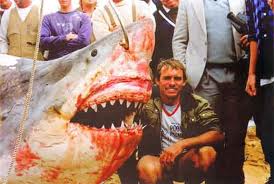
When Hong Kong was terrorised by an alleged tiger shark back in 1992, there seemed only one thing for it: summon Vic Hislop, shark-hunter and all round ocker nutjob. The chaos that ensued became the talk of the town ...


Shortly after taking up residence in Hong Kong, I awake one morning to find Vic Hislop, notorious Australian shark hunter, in my bed. Fortunately, I am on the sofa.

In happier times: Hislop catches
 the world's biggest great white
He staggers out into the living room; short, stocky, smelling vaguely of stingray and absent-mindedly scratching his nuts. Vic has just flown in from Queensland, and we’ve put him up for the night in the house my friends and I have rented in Sai Kung, a fishing village and expat hangout in the New Territories.

Nearby Clearwater Bay has been terrorised by a spate of shark attacks and The Hong Kong Standard newspaper, on a brilliant wheeze from my flatmate and uber-journo Hedley Thomas, has hired Hislop to catch the suspected tiger shark. The night he arrives, we dine on the Sai Kung waterfront as he regales us with tales of monsters pursued and killed. It becomes apparent at once that he is quite mad, possessed of a monomaniacal hatred of sharks not far short of Captain Ahab’s obsession with the white whale. What sticks in my mind from the evening’s conversation, however, is not so much the gorily graphic accounts of maneaters hooked and shot and clubbed and knifed, but an encounter with a pitbull terrier in a friend’s backyard.

Ball tearier
“Shit mate, yeah, this bastard dog just comes out of nowhere, eh,’’ he recounts in a nasal ocker whine. “And he’s coming right for me. I look around, but there’s nothing I can pick up to defend meself. I know I’ll never make it to the fence if I run. So as the fucker jumps at me, I get under him and grab him by the balls. And he lets out this yelp like he’s just been shot. He’s trying to bite me, the bastard, but I start swinging him around faster and faster, and then I let him go. And that does the trick, eh, he just lies there looking at me, and I jump over the fence.’’

From there, it’s all downhill. In short order, a lurid logo is whipped up, featuring a gaping man-eater that would do a Peter Benchley novel proud, under the rubric “The Standard’s Great Shark Hunt’’. While the snobs at the South China Morning Post, the Standard's tonier cousin, turn their noses up, the stunt becomes the talk of the town. We procure a junk – the Great Shark Hunt Mothership – and arm Vic with all manner of fearsome hooks and lines and sinkers. We scour the wet markets of Sai Kung for suitable tiger shark bait; stingrays and groupers. We print t-shirts that will go on to become collectors' items. From this point on, Vic, thankfully; will sleep on the mothership as we begin a futile and ill-fated two-week search for the shark.

Fangs for the memories 
I am charged with penning his daily dispatches and succumb to a creeping lunacy, inventing all sorts of wild rubbish to keep the story going. As I milk the Ahab angle, Vic falls ill with a virulent flu. After a couple of days, he begins to question what’s being written about his efforts. So I take to hiding his glasses so he can’t read the paper.

Hong Kong’s piranha-like pack of Chinese newspapers gets hold of the story and soon the hills of Clearwater Bay bristle with telephoto lenses as the waters around the mothership are buzzed by reporter-laden motorboats. We dole out access to Vic like jealous parents.

It soon becomes apparent that the shark has left town. Despite Vic’s best and increasingly desperate efforts, the stinking, rotten stingrays are left unmolested, the groupers ungutted, and eventually the circus leaves town too. Vic is sick and defeated, whimpering like a bull-terrier with crushed nuts, as we stick a cheque in his pocket and push him onto a plane.

Bee-el-zee-bub has a devil
put aside for meeeee
Back at the Press Club in the seething heart of Wan Chai, bathed in blinking neon from the short time hotel on the floor above, toilets awash with acrid eddies of urine, the story has taken on a delirious life of its own. The Standard’s sub-editors, a notoriously louche and drunken bunch, won’t let the thing die. For months afterwards, when sufficient brews and shots have been quaffed, they run up and down the length of the bar, hands held aloft like dorsal fins, shouting “SHARK! SHARK!’’

Hislop, however, from reports received, has never been quite the same since. The great destroyer of great whites, the tigerish killer of tiger sharks and macho crusher of pitbull balls, is a sad, bewildered and broken man, hoist on his own reeking petard, lashed to the mast of failure. The ultimate victim of the Great Shark Hunt, ironically, is the great white hunter himself.

Sunday, 9 October 2011

Blood lust on the border


Photo: Palani Mohan 
It’s only halfway through round three, but the fighters are nearly spent. ‘Super Op’, the Thai, sucks at the searing air, wipes blood from his eyes with his forearm, then launches a vicious assault, swinging haymakers with both hemp-wrapped hands. One connects, and as his Burmese opponent crumples, the Thai brings a lightning knee up into his face, pulling the other man’s head down to maximise the impact.

There’s a sickening crack of bone on bone, a geyser of blood, then a slow-motion teeter to the canvas. As the Burmese twitches, prone, a pool of bright vermillion spreads from his shattered nose, subsuming the older rust-coloured stains on the canvas. It’s a palate of carnage; the grisly record of an animosity that has spanned millennia. Super Op runs to his opponent’s corner, eyes clouded with red mist, and screams at the crowd. His primal howl is the sound any man might make, having just prevailed in one of the oldest and rawest forms of unarmed combat - Muay Haad Chuak, the ancient bareknuckle version of modern Thai kickboxing.

The Burmese segment of the crowd, half-mad with heat and cheap whiskey, press closer to the makeshift ring and scream back. A blistering sun beats down on the corrugated iron roof, making it so hot it’s hard to breathe. The larger throng of Thais send up puffs of dust as they dance victory jigs. Money furtively changes hands as bets are settled. Super Op runs back to his corner, then his legs buckle and he drops to his stool. The adrenalin overload begins to subside. Claret drips from a gaping gash above his left eye into a circular steel tray under his stool, blending with the water and ice. The sight of this gory soup stirs something in those pressed closest to the ring; they too begin to bay with demented bloodlust. The Burmese fighter is dragged from the ring by his irate handlers. ‘You stupid donkey,’ someone shouts. His head lolls, he’s missing a tooth, and his eyes seem dangerously glazed. The leakage from his shattered nose mingles with sweat and coconut oil, lending his teakwood torso an infernal sheen.  

Photo: Palani Mohan
Bareknuckle boxing has been banned in Thailand for almost 90 years, but that doesn't seem to bother anyone in the wild border town of Mae Sot in Tak Province, a stone’s throw across a shallow river from the equally lawless Burmese settlement of Myawaddy. The inhabitants of these freewheeling twin towns include illegal loggers, drug barons, human traffickers, gem smugglers, rebels, pimps, drifters, over-stayers and assorted other flotsam, all with a healthy appetite for blood sport. And so each April, during the Thai New Year festival of Songkran, authorities look the other way as fighters from the feuding nations take off their gloves and climb into the ring to settle old scores.

Photo: Palani Mohan
In 1774, after being captured by the Burmese during the sacking of the ancient Thai capital of Ayutthya, the legendary kickboxer Nai Khanom Tom won his freedom by stomping a dozen of the invader's top fighters in a row. ‘Every part of the Thai is blessed with venom,’ pronounced King Mangra, as he watched his men drop like ninepins. The story of Nai Khanom Tom dispatching the bogeymen from Burma is one of the first history lessons taught to every young Thai. The ancient Burmese armies would pass close to Mae Sot on their various incursions on their way to the famous Three Pagoda Pass, which perhaps explains why the sport – and the fierce cross-border rivalry – still thrives here.

The rules have changed a little - now there are rounds and referees, and the ring ropes and knuckles are not sprinkled with broken glass - but the fights are still nasty, brutish and short. Eye gouges and groin strikes are forbidden (if not unknown) but pretty much anything else goes. Head butts are popular. Gloves are discarded for tightly wrapped strips of hemp, which makes the knuckles rock hard. Bouts are scheduled for five rounds, but seldom go the distance. Victory is by knockout or awarded when one fighter can’t continue. If both men remain standing after five rounds, a draw is declared.

It’s a hard way to make a living, considering the very real risk to life and limb: winners take home about US$200. Losers get jeers and pain. The organisers, a coterie of Mae Sot businessmen, soldiers and police, refuse to comment on deaths in the ring, but one veteran of the sport says at least five fighters have died in the past decade. ‘Maybe more,’ he says. ‘They take a beating, but seem OK. Then they go back home and a few days later their livers or kidneys give out. It’s not something people here talk about, because a lot of money gets wagered on these fights.’

Photo: Palani Mohan
A day earlier, in a professional-standard ring by the main road, surrounded by sponsors’ banners and television cameras, seven bareknuckle bouts between more polished and experienced fighters are scheduled. There’s an expectant buzz in the crowd, who have just learned that for the first time four foreigners will be fighting alongside the Thais and Burmese. This introduces a new dynamic, as neither the Thais or Burmese want these upstarts from America to win. In the preceding weeks, the White House has been particularly vocal in its criticism of Burma’s regime, and some sections of the Burmese crowd are shouting about arrogant Americans and demanding a butt whooping. The visiting Americans train with Master Toddy, a burly chap with faded movie star looks, who left Thailand 20 years ago and now runs one of the biggest Muay Thai gyms in the United States, amidst the bright lights of Las Vegas.

‘This is a great test of courage for my men, to come here to the very home of bareknuckle fighting and prove themselves,’ says Master Toddy. His fighters – Kit Cope, Ben Garcia, Anthony Brown and Sol Mitchell – are battle-hardened veterans of American bloodsport contests like Ultimate Fighting and King of the Cage. Cope and Garcia have both been world champions in their weight classes. They’re accompanied by an MTV crew, who are filming a piece on mixed martial arts.

Not everyone is happy, though. Chavalit Kitsakdaparp, who runs Mae Sot’s Tuptimtong training camp, scours Burma for talented fighters to come and fight for him, and is complaining to anyone who’ll listen that two of his fighters are seriously outweighed by the Americans they’ve been matched with. ‘My men are tough,’ he says. ‘But this is not fair.’ Even here, it seems a good big man will beat a good little man. It’s touch and go for a few hours as to whether the fights will go ahead, but eventually Chavalit relents. ‘Everyone wants to see the farang fight,’ he grumbles, ‘so let them fight.’

Photo: Palani Mohan
Before the Americans get in the ring, there are three Thai versus Burma bouts, the first featuring Super Op’s older brother, ‘Super O’. The fighting ‘Supers’ are the sons of Chanchay Oranorong, a local legend, who fought bareknuckle for nearly 15 years and remained undefeated. Both brothers are short, nugget types with legs like tree trunks. Super O’s fight is a gruelling affair that lasts the full five rounds, an out-and-out slugfest in which he gets the better of his Burmese opponent, Jeleong Pagan, but can’t deliver the knock-out blow.

Cope is first of the Americans up, and he dances through the crowd in a bright red robe, waving and shaking his fists. He’s up against a tall, rangy Burmese named Mojo Myawaddy, and the first round is close. Not long into the second round, however, Cope delivers a lightning uppercut followed by a scything elbow strike, and it’s all over. The Burmese crumples to the canvas, dazed. The American does a back-flip for good measure, and dances back to the dressing room.

Photo: Palani Mohan
‘That was incredible,’ he exalts. ‘Did you hear the crowd? I kicked ass out there.’ The crowd has gone strangely silent, however, by the time the tall, wiry Ben Garcia emerges. It’s clear no one was expecting an American victory. When the bell sounds, the shouts and screams begin again, louder than ever. Garcia takes a beating for three rounds from a ferocious looking fellow named Josoor Rangoon. He looks to be done, when he unleashes an elbow strike seemingly from nowhere. Josoor falls twitching to the floor in the corner nearest where I’m standing, spattering my notebook with blood.

Local pride is only somewhat salvaged in the last fight of the day. Sol Mitchell is the least impressive physically of the Americans, but at 64kg, at least he’s exactly the same weight as his opponent, Tonton Rangoon. The bell sounds, as the musicians wind up into their familiar demented fugue, snake charmers on speed. Tonton leaps in with sweeping low kicks and a flurry of blows. Mitchell tries to defend, but with seconds left in the round, and gouts of blood issuing from his nose, he goes down and doesn’t bother getting back up. He peers into the lens of an MTV camera, and gives a twisted red smile.

The fighting finished, I follow Chanchay and his super sons back to his house. His mouth is bright red – from chewing betel, not blood – and he’s downing shots of whiskey like there’s no tomorrow. It’s been a good two days for his family. Two victories, $400 in prizemoney, and at least five times that in gambling winnings. It’s clear this toughest of sports has been kind to him. He has all his faculties and barely a mark on his broad, flat face. He lives in what passes for high style in Mae Sot, in a big rough-hewn teak house, with a St Bernard dog, a shiny new pickup truck and a glistening chrome hog.

Photo: Palani Mohan
‘Good boys,’ he says to his sons. Both are sporting black eyes and shy smiles. Both are preening in front of the mirror, getting ready for a night on the tiles. I ask Super O if his father makes him fight. ‘No, it’s my choice,’ he says. ‘What else would I do around here?’ Super Op smiles through fat lips and says it’s fun. ‘Winning is the greatest feeling in the world. And it doesn’t hurt when you go looking for girls.’ The brothers, too, are undefeated, having inherited their father’s lightning speed, vicious kicks and ring savvy. They’ll get a week off training now as their bruises and cuts heal. Then it will be back into it.

In a dusty ring next to the house, the fighters of tomorrow are going through their paces. Terrible tykes smashing legs into heavy bags and peppering each other with kicks and slaps. Chanchay takes another pull of whiskey, and looks out the window at the action. ‘Some talent there, I think.’ He spits a stream of betel juice out the window, and in the glow of whiskey and victory, waxes philosophical. ‘It’s a funny thing about fighting,’ he says. ‘It never hurts as long as you win.’


Saturday, 1 October 2011

Musical interlude

Here's a little thing I threw together ... funky house and breakbeat, with some new tunes and some classics

http://soundcloud.com/djlovehandles/ilovefunkyhandles


YOU CAN NEVER HAVE TOO MANY LOVE HANDLES

Sunday, 25 September 2011

Trout masks and beef hearts


The South China Morning Post has come up with an excellent wheeze for its Sunday pages: a column called Rewind, in which a classic movie, album and book, all of which tie into a theme, are reviewed. Here is my first contribution to the column, a scary encounter with Captain Beefheart's Trout Mask Replica, for a Rewind themed around madness.


WARNING: MAY CAUSE BRAIN DAMAGE
IF TAKEN IN LARGE DOSES
When Tom Waits leaps into print to give you props for bringing the crazy, you know you’ve reached some transcendental level of lunacy. Not that anyone would have dared to tell the late and very large Captain Beefheart, who once pushed his drummer down the stairs for refusing to "play a strawberry", that he was nuts.
    Madness and genius have been inextricably linked down through the ages, not least in the arts, and most especially in music. You have to be a hamper short of a picnic, the thinking goes, to get synapses short-circuiting to produce bursts of pure creativity. But there’s music by tortured geniuses and sad broken poets, and then there’s Trout Mask Replica by Captain Beefheart and The Magic Band (Straight) 1969. This is some seriously nutty stuff from a real whack job. Listen to it too often, or for too long at once, and you might begin to call your own mental health into question.
    Warns Waits: "The roughest diamond in the mine, his musical inventions are made of bone and mud. Enter the strange matrix of his mind and lose yours." The song titles alone gave me pause: Dachau Blues. Hair Pie Bake 1. Pachuco Cadaver. China Pig. Ant Man Bee. Neon Meate Dream of A Octafish. Only a madman, or someone trying to impersonate one, could cough up such frothing nonsense. As a Beefheart neophyte, I felt nervous. What if I didn’t get it? Worse, what if I did? Anyway, I sonically tip-toed past the point of no return and realized with relief that anyone who claims to ‘get it’ is a big fat bare-faced hipster-wannabe liar. You can’t ‘get’ this level of virtuoso deranged chaos any more than you can ‘get’ a tornado or a serial killer. You can only stand back, knock-kneed and awestruck, humbled with fear.
SGT PEPPER WAS JUST A DABBLER 
    "My smile is stuck, I can’t go back to your frownland," he warbles through werewolf teeth on Frownland, the opening track. And for 28 songs he sinks those fangs into your brain and chews. You feel for The Magic Band, and boy, they must have been to have even remembered which bit of what song comes next. The tunes jump about like hyper kids with Ritalin grins. Tunes? More like attention deficit symphonies. Mad chattering rhythms, a dozen different time signatures in a song, random bits of blues, rock, folk and assorted musical perversions I couldn’t begin to categorize. Random guitar wails. Gratuitous sax. And over all of it in his importuning multi-octave growl, the insistent babbling insanity of the Captain’s stream of incontinence, all fast and bulbous squids eating dough in polyethylene bags, lipstick Kleenex and mice toes scampering, girls named bimbo limbo spam, and dank drum and dung dust.
     I gave Trout Mask Replica the recommended five listens. I still couldn’t hum a single tune. Although one song that got wedged in a loose flapping fold of my brain was The Blimp, which features a hysterical loudhailer voice intoning "The tits, the tits, the blimp, the blimp, the mothership" over a demented, repetitive hurdy gurdy riff.
RANT MAN BE
    Beefheart buffs will know the legends. How the Captain, aka Don Van Vliet, had his musicians rehearse for a year to translate the simmering visions in his skull into something approaching actual songs, then recorded 20 of them in one day. How he wouldn’t let them eat or sleep or leave his house. How he made them wear dresses and subjected them to endless hours of group therapy. How he brought Frank Zappa in as producer, and how Zappa recognized instantly an evil genius at work, and how he basically left Beefheart to get on with making his magnum opus of madness. You wonder how the band put up with his abuse, but would you mess with a man who could hit High C while simultaneously blowing on two saxophones?
    Whether the Captain was a real deal loony tune, crazy like a fox or simply, as Lester Bangs suggested, ‘the only true Dadaist in rock’ doesn’t really matter. Trout Mask Replica stands alone, a jabbering beacon at the far edges of our universe, pulsing its arrhythmic logorrhea through bursts of static, warning of the epic weirdness and flights of madness that lurk in the human mind.
    "The tits, the tits. The blimp, the blimp." The horror, the horror.


Monday, 19 September 2011

Moby Dork and his excellent whaling misadventures

MOBY STICK: POLE-VAULTING IS FOR WIMPS
Photo: Palani Mohan
Sometimes you get to live out your dreams. I adore this kind of story, a no-commissions take-no-prisoners risk-fest, setting off for some far flung corner of the world where weird people still do strange stuff. Moby Dick has long been one of my favourite books. I love Melville's dense and compelling prose, his flights of fancy (see The Whiteness of the Whale) and his general storytelling genius. So it was absolutely mind-blowing to find myself in a flimsy craft with some very rugged chaps paddling after a large and increasingly irate sperm whale just like they did in Melville's day. The whole enterprise was so very nearly a bust. Photographer Palani Mohan and I had been languishing in the little village known as Lamalera for nigh on a month without the sight of a single sperm whale and were about to call it quits when on our last full day on the island of Lembata, I ventured out with one of the whaling crews mainly out of sheer boredom. As you will see with what follows, the boredom didn't last long. Of course the demise of the great fish was heartbreaking, but for the villagers, among the last on the planet to practise true subsistence whaling, it was just another day at the office. Here's the story. And some awe-inspiring images.


When the first spouts were seen and we bent our backs to the oars, I began to wish I'd left Moby Dick undisturbed in my bookcase. For we were paddling out to do battle with leviathan, armed with needles and pins, in a boat made of matchsticks, and my mind was awash with the nameless terrors of Herman Melville's white whale.

"Hiva! Hiva!'' shouted the crew, calling on their ancestors, asking that courage not fail them. Each stroke brought us closer to our prey - an 11-metre, 20-tonne bull sperm whale churning lazy circles in the warm blue sea, proclaiming his presence with each misty roar of his spout.

Half an hour earlier, the unforgiving equatorial sun just past its zenith, the Tena Puka had been creeping back towards the Indonesian village of Lamalera, on the far eastern island of Lembata, where for more than three centuries men have gone down to the sea in wooden boats to hunt whales. The barest hint of a breeze luffed the woven palm-frond sail. Men dozed in a palm-wine torpor. "No whale today,'' said the captain, Sipri Demon, half-asleep at the tiller.

Two other boats, known as pelendangs, had been out with the Tena Puka, describing fruitless tacks across the Savu Sea since sun-up. Not a single spout had been descried since early April, more than six weeks ago, when a smallish sperm whale calf was caught. Meat was running low, and a palpable despondency was beginning to settle over the hunters and their families.

 "Clan trouble,'' Captain Demon explained that morning, shaking his head, as we pushed the boat down the glittering black beach and out through the breakers. Lamalerans believe any disharmony in the village will keep the whales away. The night before, in a noisy public meeting, a simmering feud over the division of meat from the last catch had finally been put to rest.

I settle into a sweaty trance, the Tena Puka pushing half-heartedly against indolent waves. We're half an hour or more behind the other pelendangs, who have almost gained the shore, when we hear the first shout.
MOBY TAIL: I AM JUST OUT OF FRAME,
REDECORATING MY BOXER SHORTS
Photo: Palani Mohan 
"Baleo! Baleo!'' There she blows! One of the youths who keep vigil on the hilltop has seen the telltale puffs of a sperm whale spout and raises the cry.

We scramble for the oars. Captain Demon is dancing a little jig as he swings the prow seaward. He grabs my shoulder and gives me a shake. "Paus!  Paus!'' he hisses, eyes suddenly full of blood and thunder. It means "Pope fish'' in Bahasa Indonesia. (It is taboo for the hunters to speak the whale's "real'' name - "kotakelema'' in their native tongue, Lamaholot - while at sea.)

"Hiva! Hiva!'' we chant, blistering our palms as we pull. Elias the harpooner is unhurriedly honing his barb on a whetstone. "Wocka wocka'' sings the steel as a gleaming edge replaces dull rust.

Each minute seems to stretch out interminably as we cut a foaming wake towards the whale. Suddenly the wet blasts sound close now, very close, and I put my oar down for a moment and turn to face the front of the boat just as the whale - not five metres in front of us - flings its flukes skyward and disappears into the depths. The tail is at least three metres across, terrifying and beautiful, sprung with an ineffable tendinous strength.

For five minutes, maybe more, there's calm. Then, off my side of the boat, a roiling disturbance and a rising black shadow, and the beast's huge block of a head bursts from the blue like a submarine that's just blown its tanks, covering us in acrid spray with a bellowing snort from its spiracle.

Curious, or befuddled, it floats there, spouting and eyeing us. It could easily outrun the boat but doesn't, and Captain Demon leans on the tiller as we row furiously. Elias fits the harpoon into its bamboo shaft, and with unerring balance dances onto his platform; thick bamboo sticks lashed to the Tena Puka's prow. Slowly the whale starts to swim, undulating its flukes. Elias crouches, his dart cocked.

At last the whale senses something amiss, and starts to churn the water into white curd. It lists like a stricken ship, giving Elias what he's been waiting for - a clean shot at the vulnerable spot behind its flipper. Noiselessly he leaps: burying his barb into blubber, flailing as he slides off the broad black back.

MOBY BLOWS: THE 'WHALE STONE' 
AND HUNTERS' LOOKOUT
 In a chaos of foam the whale begins its panicked run, and the rope jerks tight, quivering and humming with a wild electricity. Elias scrambles back into the boat as we take off on what Yankee whalers called the "Nantucket sleigh ride''.  In front of me, Franciscus, one of the "matros'', or crew, loops the line around a timber post to increase the drag and stop it whipping about. The rope is a constant threat; when the whale sounds it can cut through flesh like butter, or drag a careless hunter down to a watery grave.

Minutes of this, being pulled about like a toy, then the whale slows. Gathers its strength. Regards us with a baleful eye. It hoists its flukes into the air and smashes them down two metres from where I'm sitting. There's a blast like a thunderclap. Dion, another matros, shoves my head none too gently below the gunwhales, shouting “down, down!’’.

My ears are ringing and I feel like my bowels are about to fail me. "Could annihilation occur to matter, this were the thing to do it,'' wrote Melville of the sperm whale's tail. "No ribs of man or boat can withstand it.'' The whale wields its flukes like a gladiator's mace again, further away this time. Spray flies. Then he sounds, and rises under the boat, knocking us off our perches with a great thump. The timbers quiver and groan. "Santa Domingo,'' cry the crew and I'm jabbering away in tongues, summoning half-remembered prayers from strange cobwebby places.

Elias, fearless, leaps upon the beast again, embedding another harpoon. The whale rolls and roils, tangling the ropes around its thick torso. The two other pelendangs, Java Tena and Demo Sapan, are scudding toward us, sails flapping, oars flying. Both manage to get harpoons fast to the whale, then back off, swiftly paying out rope, leaving us to face the brunt of the whale's mounting fury. 

IT is hard to imagine a more apt setting to hunt sea monsters than Lamalera. The village, about 900km east of Bali, oozes portents; beyond the steep green hill that divides the twin communities of Lamalera A and B rear volcanic peaks, including the active, smoke-belching Ale Ile. On clear mornings you can see across the Ombai Strait, a sperm whale breeding ground, to Timor.

The beach is dotted with bleached whale bones, and the restless earth leaks a sulphurous stink, lending credence to the fire and brimstone sermons each Sunday (the Catholic mission has been established for more than a century and most of Lamalera’s 2000 inhabitants are Christians). A strong streak of animism survives, however. On April 30, the day before the official six-month hunting season begins, elders plod up the mountain to the whale stone, a panoptic perch that resembles a sperm whale, and offerings are made to the whale god.

Only toothed whales, such as sperm and pilot whales (as well as manta rays and dolphins), are hunted by the Lamalerans. Plankton-eating behemoths like the blue whale, regularly sighted in the Savu sea, are sacred - the islanders believe their ancestors arrived on the back of one. Lamalera is the last place on earth where sperm whales are regularly harpooned from traditional wooden vessels – and after May’s acrimonious International Whaling Commission meeting, it may for some time be the only place in the world where subsistence whaling of any kind occurs.

In a move spearheaded by an angry Japanese contingent smarting after losing their battle to have the ban on commercial whaling lifted, subsistence whaling by native american and aboriginal tribes in the United States and Russia was banned. The tribes, included Eskimos and the Chukotka people, hunt the more docile plankton-eating bowhead and grey whales.

MOBY DOCKED: LET THE STENCH BEGIN
Photo: Palani Mohan
The Indonesian government tolerates the hunt on Lamalera, viewing it as true subsistence whaling (in any case, Indonesia is not a signatory to the IWC). In a good year, 20 or 30 whales may be caught; in a bad year, none. The meat is eaten and bartered with hilltribes for grains, fruit and vegetables, while the oil – both the valuable “spermaceti’’ from the head and the lesser stuff the drips from strips of blubber - is used to fuel lamps.

Like the Quakers who dominated the Yankee sperm whale fishery in the latter part of the 19th century, Lamalera's whale hunters believe God is on their side.  "Faith is very important,'' says Papa Ignatzius, 48, master boatbuilder and the grizzled harpooner of the Demo Sapan. His beachside house bears testimony to successful hunts; huge vertebrae form fretwork above the doors and the bleached arches of ribs decorate flowerbeds.

"When you're about to jump onto a whale, you aren't thinking about your wife or your kids or whether you remembered to kick the dog that morning,'' he says. "You are praying to God with all your might to guide your harpoon.'' No small measure of faith is invested in the pelendangs, which take a beating during the hunt. Crafted by hand from a local timber similar to teak, the boats are held together by an elaborate system of wooden dowels and pegs. They measure about 10 metres in length, weigh around a tonne and carry a crew of eight to 12. Twenty-five of the craft sit under thatched huts on the beach, but fewer than half of them have active crews. Lamalerans believe their pelendangs, named after ancestors, are invested with an immortal soul. Eyes are painted on the front so the boat can see. 

"If I make a mistake of even one millimeter when building a boat ... disaster,'' says Papa Ignatzius. "We call the sperm whale the "doctor fish'', because he is so smart. If there is a mistake in the boat, a weakness, then the whale will strike it in exactly that place.''

None of the villagers know just how long ago their ancestors arrived at Lamalera, or when they first summoned the nerve to harpoon a whale. But a Portuguese document dated 1624 describes the hunt in some detail. If accurate, it means the Lamalerans had the business down to a fine art two centuries before Melville conceived Ahab and his monomaniacal quest.

How much longer the hunt will continue is open to conjecture. While the elders say that as long as there are Lamalerans, they will hunt whales, you can't help noticing many of the pelendang crews are a bit long in the tooth. The younger generation have largely opted for less risky occupations.

MOBY WHO? A WHALE HUNTER OF LAMALERA
Photo: Palani Mohan 
"I don’t know what the future holds for us,'' says Noel Beding, 24, a computer studies graduate from a Bali college who now helps run his father's homestay in Lamalera B. "We want to keep our traditions alive, but maybe in the future we can make our living from tourism. I don't want my kids to have to hunt whales. I want them to have electricity and television and a good education, to see the world.’’

His father, Abel Beding, hunted whales as a youth. "I'm too old for that now,’’ he says. “It’s a hard living. You’re either sitting in the boat bored stiff or worrying you’re about to die.'' These days he makes a living renting rooms to the trickle of tourists who make their way to Lamalera. “Things are changing here,’’ he says. “Lamalera is waking up to the modern world.” A couple of years ago, he bought a generator and a television. Children gather in front of his house each night to gape at Sylvester Stallone movies.

Clouds are gathering on Lamalera's horizon. Lembata Island, until last year part of Flores district, has now been made a separate district, which means more funds from Jakarta. Local officials are keen to exploit the tourism potential of the whale hunters, and have begun construction of a new road that would cut dramatically the travelling time from the main port of Lewoleba - currently a five-hour, bone-jarring vertiginous odyssey in an ancient Land Rover.

The barter economy has been disrupted by the modern world’s intrusion. Tourists are welcome to go on a whale hunt, provided they pay. "I think people got a bit greedy after a Japanese documentary crew was here four or five years ago,'' says Abel Beding. "They splashed lots of money around.''

A day out on a pelendang is 35,000 rupiah. If a whale is caught and you want to take photographs, the fee is 150,000 rupiah, or 700,000 for video. You can make your own sacrifice at the whale stone, but it will cost you 500,000 rupiah. The charges seem fair, considering the uniqueness of Lamalera and the very real risks whaling poses to life and limb. But if the hunt becomes a  gory tourist bloodsport rather than true subsistence whaling, public opinion - generally sympathetic - may turn against the whale hunters.  
  
MOBY DEAD: HUNTERS
AND THEIR PRIZE
Photo: Palani Mohan
The sperm whale, also known as Physeter macrocephalus, or the cachalot, is the grand prize for Lamalerans. The meat from a big bull can sustain the village for months. Adult males can reach lengths of more than 20 metres long and weigh 50 tonnes. Females rarely exceed 13 metres.

Sperm whales have the largest brain of any animal in earth's history - six times the size of a human brain – and a penis as long as the average NBA player is tall. They are covered in a tough layer of blubber up to a foot thick, and their four-chambered heart weighs as much as two grown men.

Their main source of food is the giant squid, which lives in deep ocean trenches. Sperm whales can dive to depths of three kilometres, staying under water for up to two hours. They have the largest head of any animal, up to six metres long and three metres high. The top half contains a case filled with spermaceti, a fragrant oil prized by the Yankee whalers for its clean-burning qualities and use as a lubricant. Below the case is a waxlike honeycomb structure believed to be used in echolocation, pinpointing food in the inky depths, and regulating buoyancy. Ambergris, an ash-coloured, sweet-scented substance found in lumps in the sperm whale's intestines, is still prized as a fixative for perfumes.

A full-grown bull's lower jaw may reach five metres, studded with more than 50 curved teeth up to 15cm long, which fit into holes in the upper jaw when the mouth is closed. Sperm whales are generally social animals. Pods consist of females and calves, and "bachelor schools'' of young males. Older bulls are solitary, but will engage in fierce battles with rivals for the right to mate (this is accomplished by swimming upside down under the female). They can live as long as 70 years, and since the ban on commercial whaling in the 1970s, a population which some scientists believe dipped as low as 200,000 worldwide, is beginning to recover.

Melville, who went whaling for several years, found inspiration for his classic novel Moby Dick in the true story of the whaleship Essex, which was charged head on and sunk by an enormous, enraged bull sperm whale in 1820.
   
MOBY GONE:
FAREWELL TO LEVIATHAN
Photo: Palani Mohan 
WHALING is without doubt a risky business - just ask Benedictus Demon. Like a modern-day Ahab, he hobbles about on one leg, the other a wooden stump. A matros on the pelendang Kebakopuka, the 52-year-old recalls a huge pod of whales being spotted one June morning in 1996.

 "Two other boats had already harpooned whales, and about 8am we fastened onto a big one, about 13 metres. I was the harpooner's assistant, so my job was to pay out the rope and make sure it didn't get twisted. Well, the whale was putting up a hell of a fight, and I didn't notice the rope had become looped around my leg, below the knee. When the whale dived, the rope cut right through my leg, even the bone. It took six hours to get to the hospital. I thought I was a dead man.’’

Three years earlier, the boat was dragged more than 80km, almost to Timor, by a massive bull. “After a day and a night, we decided to cut the rope,’’ he says. “We drifted for three days, with no food and hardly any water. We were all nearly dead when a cruise liner picked us up near Komodo.''

Marcelinus Ratu, a 28-year-old matros on Demo Sapan, could be forgiven for hating whales, for making revenge his quest. When Marcelinus was still in his mother's belly, his father was smitten by a whale and died instantly. But there are no hard feelings, he says. "It’s just a job. I’m not out for revenge. Actually, I like and respect whales, but we need to feed our families.’’

Cowering in the Tena Puka as the flukes fly, I can’t help pondering his father’s fate. The whale wheels around, using the featureless expanse of its head as a battering ram. “Santa  Domingo,'' cry the crew, baling furiously as water seeps through the straining timbers. Between flurries, the crew haul on the rope, getting us up alongside the whale, then they lean out with sharp knives and furiously stab into the blubber, trying to get at the vital organs. One of the crew manages to stick a gaffer hook deep into the whale's spiracle, prompting a savage burst of tail-swatting. Knife clenched between his teeth, Franciscus swims out to the raging fish and opens up a cut behind its hump. Fresh gouts of blood stain the sea.

He dog-paddles back to the boat, just as the whale coils and unleashes the full power of its tail, snapping off the harpooner's platform and staving the inch-thick planks of the prow like so much balsa wood. The hole is just above the waterline, but the boat has been fatally weakened. Rope is paid out until we are at a safe distance from the whale, and the Demo Sapan charges in to take up the fight. “Scared?’’ laughs Franciscus, as he dives overboard and strokes off to continue the fray.

Scared scarcely begins to cover it. After nearly an hour in a half-flooded boat being battered by a big angry fish, complete and abject terror would be a more accurate summation of my mental state. The crew are laughing at me and making loud spouting sounds. Franciscus has somehow straddled the back of the whale and works his knife up and down, effectively hobbling the deadly flukes. Each time it tries to hoist its tail, the gash gapes wider, bleeding crimson. “Baleo!’’ someone shouts, as more spouts are spied. Half a kilometre away, five or six sperm whales have stopped to investigate the commotion. They lift their heads out of the water, swinging them from side to side. They circle us, stop, and swim slowly away.

It takes three more hours until the great fish expires, jaw horribly agape, spouting clots of gore in its final agonised writhings. At last its island bulk lies still; the pool of blood thinning, mingling with the pinks and oranges of sunset.

MOBY BONE: LAST
 OF THE WHALE HUNTERS?
Photo: Palani Mohan
It's almost dark by the time the corpse is towed back some 5km to shore, hauled into the shallows and secured with ropes. The entire populace seems to be on the beach, hopping and babbling beneath flaming torches. In the fading light, a massive blue whale is sighted, cruising just 20m offshore, spouting its towering spout. A good omen, the villagers agree.

At sunrise, butchering will begin. Great chunks of rich meat will be divided up, according to strict and ancient formulae. Spermaceti will be ladled into buckets. Women will pad about, squares of blubber balanced on their heads, dripping oil down their backs. By midday, a sickening, pore-deep stench will have settled like a blanket over Lamalera.

But tonight belongs to the whale hunters of tomorrow: they howl and cavort on the beach, terrible naked imps bathed in blood and torchlight, leaping from beached boats to hurl slivers of bamboo at imaginary monsters.


Tuesday, 13 September 2011

God is a DJ

Midday, Sunday. Maybe a year on from my first rave party. I’m slumped in an overstuffed, ratty couch in Hayden’s living room. Hayden is Hong Kong's underground DJ non pareil, an elusive, pretty, vampiric figure who sucks an eclectic crowd into his orbit. We’ve just walked up six flights of garbage strewn stairs. I, as the newest acolyte, got to carry his heavy record box. Sarongs in psychedelic patterns have been draped over the windows, drenching the room in an eerie glow. A lava lamp bubbles in a corner. 

A huge poster of a half-naked Asian woman flanked by faded record covers adorn one wall. Sagging shelves line two others, packed to the ceiling with vinyl in well-worn sleeves. On a large coffee table are overflowing ashtrays, ripped packs of Rizlas, a huge glass bong and a strange contraption crafted from a juice container and a couple of foil-wrapped straws. Hayden is already back on the decks despite having just played a marathon set in Neptunes. The music is ear-bleedingly loud.

The Saturday night rave and debauched after party has by now become a regular weekend routine. I know I am doing terrible damage to my brain, but I am having so much fun, or at least I tell myself I am, that I don’t really care. By now I'm necking up to three pills in an evening, trying to recapture that elusive first experience. I am also finding myself regularly around at Biscuit's on a Tuesday evening, procuring cocaine to bounce back from the “blue Monday’’ syndrome.

    “Hayden,” I shout. “Don’t the neighbours ever complain?’’
    “Regularly,’’ he says, in a clipped British public schoolboy accent. “But fuck them.’’ His Eurasian good looks, commanding height and arrogant air create a magnetic aura. Arrayed around the living room are eight others; his beautiful but spaced out girlfriend, some local club chicks, a couple of brain-fried heavies, another DJ, and Biscuit. Everyone is off their heads, nodding along to the music. Conversation is, well, limited.

Hayden puts his headphones down, and nods at the fruit juice contraption. One of the heavies grunts his assent, and from a glassine bag on the coffee table shakes out some cloudy crystals onto a creased piece of aluminium foil. Hayden picks up the homemade bong, and as the heavy waves a lighter beneath the foil, wisps of smoke disappear into the foil-tipped straw. 
    “What is that stuff,’’ I ask the Eurasian girl sitting next to me on the sofa. 
She looks at me with disdain. “Ice. Meth. Bing. Duh.’’

The foil and bong do the rounds. Some partake, others refuse. I am fascinated but uninterested, wrapped up safe and warm in my ecstasy blanket. Although I do snort a line when Biscuit pulls out his coke stash and chops out some rails on a chipped dinner plate. I hand him back the rolled up thousand dollar note and he leans over. 
   “Stay away from the other stuff mate.’’ He nods towards the foil, which is now stained with a poisonous dark treacly trail. “That’s bad news, that is.’’

I stand up and move over to the decks, where Hayden is back in control. I focus intently on what he’s doing. Then I screw up my courage and ask if I can have a go.
    “Sure,’’ he says, with an evil grin. “But it’s not as easy as it looks.’’
One record is playing. He hands me another.
    “Here, try and mix this in. You have to match the beats exactly.’’ He points at the mixer. “These are the faders. They control the volume of what you hear playing. The knobs here are the bass, midrange and treble. This light here tells you which channel you hear in the headphones. And these sliders here on the decks are the pitch control.’’

I put the headphones around my neck and cock one side up over an ear, like I've watched Hayden do so many times. I put the record on the turntable, start it playing and with shaking hands lower the needle onto the first grooves. Noise explodes in my ear and the beats are impossibly fast. Hayden laughs and stabs at another button on the turntable.
    “Some records are 45rpm. Some are 33,’’ he explains.

Now the beats are at normal speed, but they are out of sync with the record that’s playing. With increasing panic, I slide the pitch control up and down, trying to find the right beats per minute. Then I feel I have it. As I’ve watched countless DJs do, I wind the record back to the start, count in the beats and then set it spinning. With thudding heart in mouth, I slowly slide the fader up, and for five seconds, ten, the two tunes are playing in sync. I’m mixing. I’m a fucking DJ! Then it all goes horribly wrong. The beats get out of sync, drowning the room in a horrible syncopated mess. Frantically I stab at the record, speeding it up, slowing it down, but it’s no use. I’ve lost it. The Eurasian chicks grimace. One covers her ears.

    “Boo. Sack the DJ,’’ sneers one of the heavies.
I hand the headphones back to Hayden.
    “Not bad for a first try,'' he smirks

I sit down, sinking back into the sofa. We’ll sit around listening to music as our brains slowly baste for hours, drifting, timeless, aimless, mindless, before people begin to make their excuses and slope off home. And all the while I’m sitting there, I’m thinking, man, I have got to get on those decks again.